Invisible in 0.2 Seconds: The "Invisible Man" Tech of the Deep
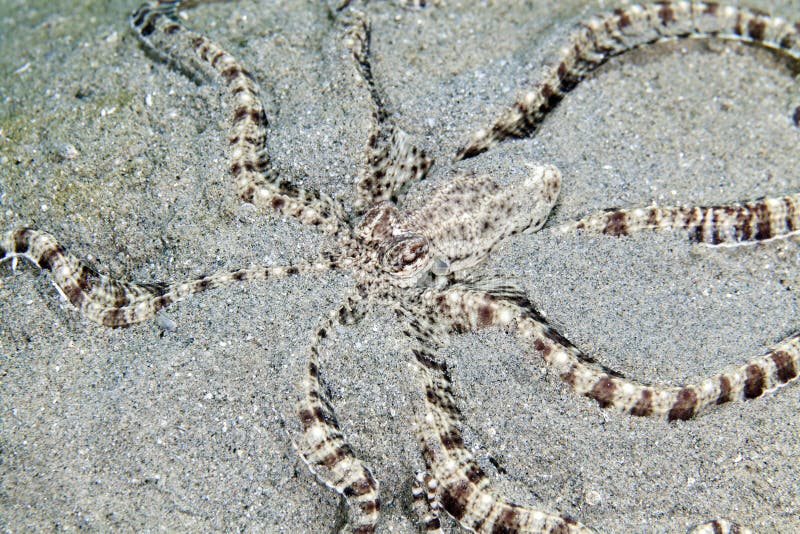
If you’ve ever tried to play hide-and-seek with a toddler, you know it’s usually pretty pathetic. But in the ocean, hide-and-seek is a high-stakes game of life and death—and the octopus is the undisputed world champion.
I was watching some footage recently, and I had to hit the rewind button three times because I literally didn’t see the octopus until it moved. We aren’t talking about "blending in" like a soldier in camo; we’re talking about near-instant invisibility.
Here is the "tech" breakdown of how they pull off the ultimate vanishing act.
The Three Layers of "Pixels"
An octopus doesn't just have skin; it has a living, breathing high-definition monitor wrapped around its body. Their camouflage works in three specialized layers:
Chromatophores: These are the top layer. Think of them as tiny balloons filled with pigment (reds, yellows, blacks). By stretching these balloons with their muscles, the octopus can change its color in 1/5th of a second. For comparison, a chameleon takes about 20 seconds. In the "Octo-zone," 20 seconds is an eternity!
Iridophores: Beneath the colors are these "mirror" cells. They reflect light to create those shimmering, metallic blues and greens you see when an octopus gets excited or defensive.
Leucophores: These are the foundation. They reflect the ambient light of the ocean, giving the octopus a ghostly white base that helps them match the brightness of their surroundings.
Texture Shifting (Wait, It Has Spikes Now?)
This is the part that truly messes with my head. They don't just change color; they change shape. Octopuses have tiny muscular structures called papillae. They can transform their skin from "smooth and slippery" to "jagged and rocky" almost instantly. They can mimic the exact texture of a clump of seaweed or a piece of jagged granite. It’s not just a visual trick; it’s a physical 3D transformation.
The "Colorblind" Mystery
Here’s the absolute kicker: Octopuses are technically colorblind. How does a creature that can't see color manage to match the colors of a coral reef so perfectly? Scientists recently discovered that octopus skin contains photoreceptor genes. Essentially, their skin can "see" light and shadows independently of their eyes. They are literally sensing the light around them and reflecting it back without even having to think about it.
The Mimic: Taking it to the Next Level
While most octopuses hide, the Mimic Octopus takes a different approach: it puts on a costume. Instead of just "disappearing," it will shape its body to look like a venomous sea snake, a flatfish, or a spiky lionfish. It knows what its predators are afraid of, and it pretends to be that thing. That’s not just biology; that’s psychological warfare.
The Octo-Zone Takeaway
We spend billions of dollars trying to develop "stealth tech" for planes and gear, but the octopus has been doing it better using nothing but its nervous system and some pigment sacks for millions of years.
I’m curious: If you had the octopus’s camouflage for 24 hours, where would you go? (I’d probably just use it to avoid people at the grocery store, let's be real.)
Drop a comment below and let’s talk about the weirdest camouflage you’ve ever seen!


Comments
Post a Comment